The alternatives: harmonic, RV, and multi-stage planetary
In industrial robots, harmonic drives, RV reducers, and multi-stage planetary gearboxes dominate the joints. Are they good solutions for humanoid robots as well?
Harmonic: the precision specialist
The harmonic drive earns its dominance on two strengths: no backlash — no free play between input and output, so the joint sits exactly where commanded — and a big reduction in a small, light package, ratios of 50:1 and up on the joint's own axis. For an industrial arm placing a tool to a fraction of a millimetre, that pair is close to unbeatable. Four things come with it.
1. Efficiency, and the heat it leaves behind. The gear train works by flexing a thin steel cup (the flexspline) against a rigid ring, and that continuous deformation costs power — more so at partial load and in the cold, where a walking robot lives. The lost watts drain the battery and heat a sealed joint with no airflow. Honda's ASIMO, on harmonic legs throughout, walked in a permanent crouch and emptied its battery in about an hour.
2. It does not backdrive. Force applied at the output reaches the motor only weakly, and that matters most exactly where a robot shares space with people. Safe contact depends on force control, which in turn depends on a joint either yielding mechanically or reporting the force it feels. A harmonic joint does neither: compliance has to come from software fast enough to react, and output torque cannot be read from motor current with useful accuracy. The generic remedy, wherever a gearbox is not backdrivable, is a torque sensor on every joint intended for force control — a cost paid dozens of times per robot.
3. Durability is limited by the same flexing cup. The flexspline is deformed twice per input revolution, so its fatigue life sets the drive's life, and a hard enough impact makes its teeth skip over the ring. An industrial arm can be specified around this: known payload, guarded cell. A humanoid works where the shock spectrum is not knowable in advance.
4. The cup is expensive to make. A thin-walled steel part that must flex millions of times and carry accurate gear teeth is not simple to make: wall section, heat treatment, and tooth accuracy must hold together at once. That cost is structural rather than incidental, and it is paid on every joint.
Where it fits in humanoid robots. The wrist and the precision and roll axes — neck, forearm rotation, waist and hip yaw — which carry modest load, see little shock, and can delegate compliance upstream.
RV / cycloidal: the industrial workhorse
The RV reducer answers the industrial arm's question superbly: very high resistance to twisting, free play measured in hundredths of a degree, tolerance of shock at several times rated torque, and years of three-shift life. Bolted to a factory floor, where mass costs almost nothing, that combination is close to ideal.
1. Mass, for capability the joint never uses. The RV buys its stiffness and its torque capacity with material — cheap on a factory floor, expensive on a limb. Even its smallest frames are specified for industrial loads well beyond anything a humanoid joint sees, so the mass arrives attached to headroom that goes unused, and every gram of it spends payload before the robot picks anything up.
2. Friction, and the opacity that follows. The crankshaft-and-pin architecture that produces the stiffness also carries high friction and significant drag with no load applied. The consequence matches the harmonic's: a joint that resists being driven backward and cannot report force through its motor current.
3. Cost. Crankshafts, needle bearings, precision cycloidal discs, pin rings — each machined and assembled to close limits. That makes the RV among the most expensive reducer types per unit, structurally rather than incidentally. An industrial buyer amortises it over a decade of uptime on a six-axis arm; a humanoid multiplies it by dozens of joints against a consumer-adjacent price target.
Where it fits in humanoid robots. It is hard to name a joint where it does. Everything it delivers is bought with the three things a walking machine cannot spend: mass on the limb, friction in the force path, and unit cost paid once per joint. It is an outstanding answer to a question the humanoid is not asking.
Multi-stage planetary: the default, stacked
The planetary gearset is the robotics default for good reason: few part types, good forward efficiency, tolerance of manufacturing variation, low cost at volume — and, at modest ratio, genuine backdrivability.
The difficulty is ratio: a single stage runs out of practical reduction around 8–10:1, well short of the 25–40:1 a humanoid joint wants. From there the field splits.
Quasi-direct drive keeps the single stage and lives with the low ratio, pairing it with a large, high-torque motor. Transparency and backdrivability are excellent, which is why dynamic legged robots favour it. The bill arrives at the motor: torque the gearbox does not multiply has to be produced directly, in copper, current, and mass carried on the limb.
Stacking a second stage reaches the ratio instead, and that is where the trouble starts. The part count doubles — two carriers, two sets of planet bearings, two meshes in series, and the output bearing still added on top — usually a cross-roller, routinely the most expensive component in the box. Losses and backlash multiply with every mesh and carrier. And reverse friction compounds fastest of all: backdrivability was the reason to prefer a planetary over a harmonic, and stacking is precisely what erodes it.
Where it fits in humanoid robots. Almost everywhere, today: the two-stage planetary is the incumbent choice for load-bearing limb joints, and a genuinely reasonable compromise — but a compromise, ratio bought with parts, length, losses, and transparency.
The trilemma
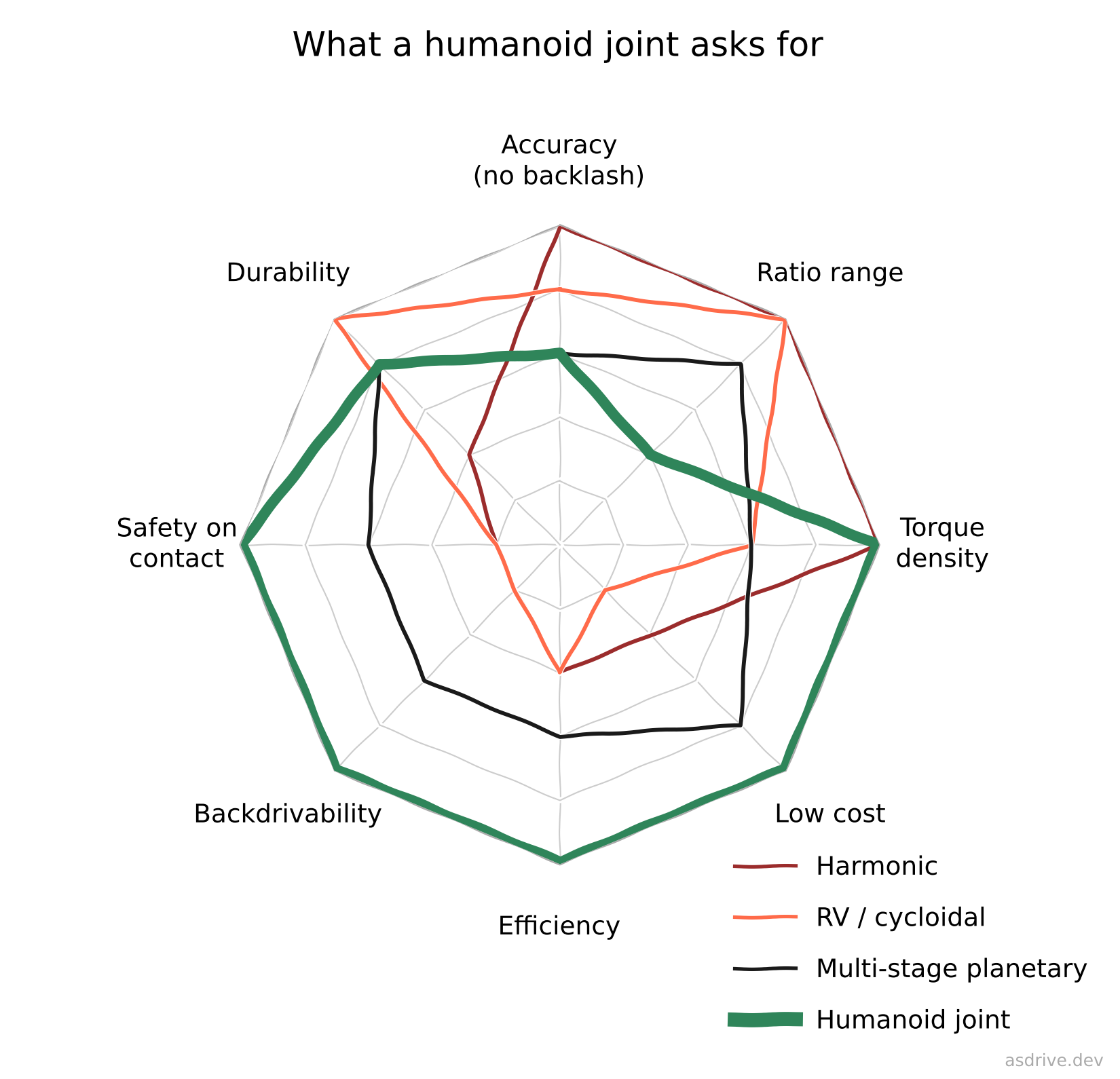
Drawn on one card, the pattern is stark. Five of the eight axes are the ones a humanoid joint asks everything of: torque density, low cost, efficiency, backdrivability, and safety on contact. The three incumbents reach full marks on exactly one.
The harmonic drive is missing the whole left side. It delivers the torque density, then gives up backdrivability and contact safety almost entirely, wastes energy a battery-powered machine cannot spare, and costs too much to fit thirty times into one robot. Its surpluses sit where the joint asks least: accuracy beyond what an output encoder needs, ratios far past the humanoid band.
The RV reducer is missing more. Its two peaks — ratio range and durability — sit on the axes the humanoid ranks lowest and third-lowest. On the five that matter it is last or joint-last on four, spared a clean sweep only by torque density, where it merely ties the planetary.
The multi-stage planetary is missing nothing in particular and everything in general. No collapse, no peak: it reaches the ratio, survives the shocks, backdrives tolerably, costs less than the other two — and still falls short of the requirement on all five axes that matter most. That is what a compromise looks like drawn as a shape.
Each of these transmissions is the right answer to its own question. The humanoid's load-bearing joint is a new question.
The fourth corner
The next notes cover the design targets of ASDrive, and why the ratios landed at 27:1 and 34:1.